
Small businesses are vital for economic growth. Over 99% of the estimated 5.5 million businesses in England and Wales are small businesses with fewer than 50 employees. Collectively they employ an estimated 13 million people and have a £1.6 trillion turnover. They provide us with the products and services we need and are part of the fabric of our communities.
Yet they rarely have the in-house legal capacity to deal with the legal issues they face.
We have run a dedicated survey since 2010 to understand the legal needs of small businesses and how they deal with them. In 2025, we ran the fifth wave of the Small Business Legal Needs survey. This survey was adapted slightly from the previous wave to include questions on the financial and wider economic impact of legal issues and the influence AI may have on how small business interact with legal services.
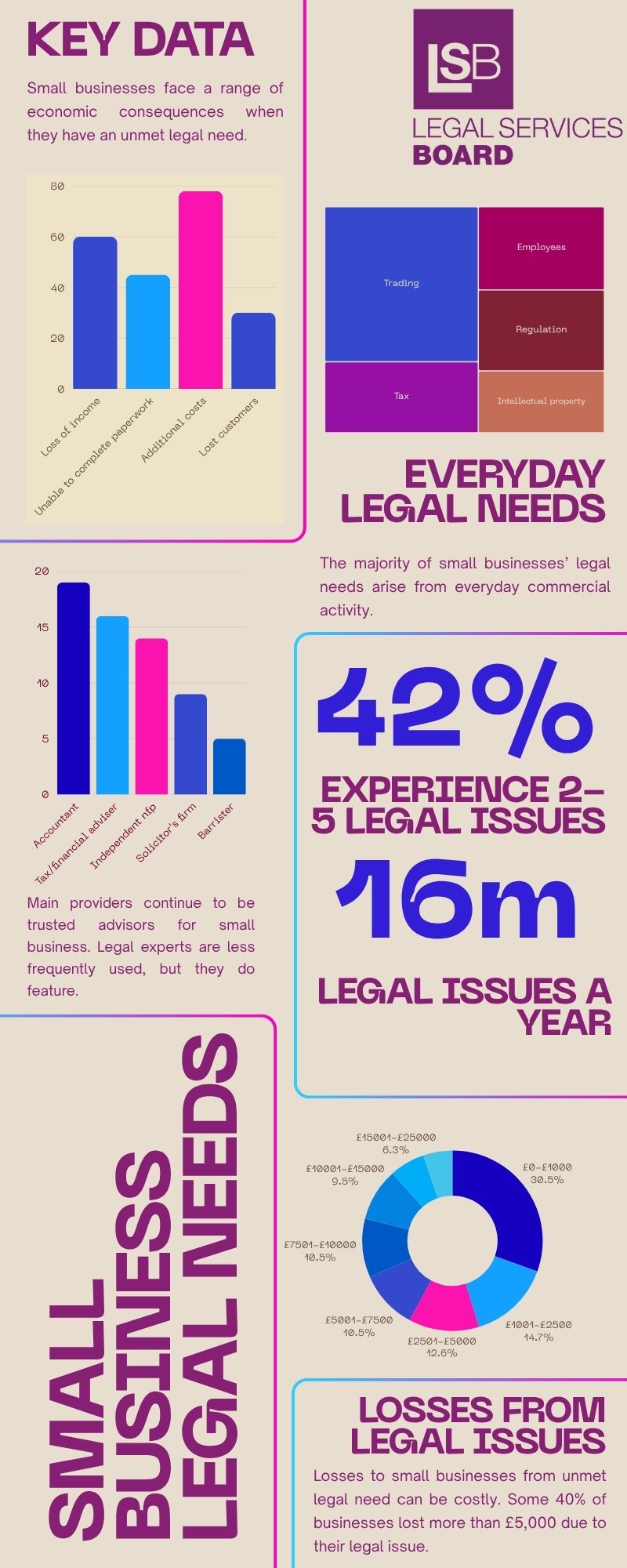
The headlines from the survey are:
- Legal Issues Are a common Feature of Modern Business Life
- 36% experience at least one legal issue.
- Each businesses faces an average of 2.8 issues per year.
- Most common issues impact day-to-day commercial activity – such as late payments and delivery of goods and services.
- These issues have a wider economic impact – loss of income and work etc.
- Financial Impact – Not All Legal Issues Are Equal
- Some issues have much larger financial consequences – 40% produce more than £5,000, one in ten greater than £15,000.
- Late Payments produce large costs, with 35% taking up resources to chase down payments and 28% resulting in small businesses being unable to meet bills.
- Sole Trader and Micro businesses are more exposed to these financial losses than large businesses.
- Small Business Outcomes Vary.
- Most small business manage legal issues without specialist knowledge, yet those ones who have access to this have better outcomes.
- Legal confidence emerges as a powerful predictor of behaviour.
- Capability is linked to outcomes – those with higher legal confidence and access to justice more often secure better outcomes.
- Business rely on Trusted Advisors more often than professional legal support.
- Accountants and Tax advisors are used more often than Solicitors or barristers.
- Shopping around for legal services has greatly increased (+20%-points)
- Technology is changing how businesses seek support – with AI having greater influence.
- Technology is making it easier to find providers and information about their services.
- Unmet Legal Needs remain Substantial amongst those with a legal need.
- 11% of businesses were identified as having a legal need, with 9.4% having an unmet legal need.
- Wider factors than cost determine this, a failure to seek assistance and struggling to find appropriate help are also important.
- Capability and unmet legal needs remain closely connected. Those with low legal confidence and access to justice are more likely to have an unmet need
Going forward we are recommending:
- Tackle the biggest barriers to growth – focus on tackling legal issues that most affect economic activity, such as late payments.
- Strengthen legal capability as part of business capability – increase confidence and access around services.
- Make legal support easier to find and access – such as using technology to guide those in need to adequate sources of support.
Find out more:
- Read the Executive Report of our findings
- Infographic summarising the report on one page of A4
- Explore the data using the Data Tables
- View our presentation outlining the results of our findings